Every fintech founder already knows the goal: fund the flow — the loan book, the receivables, the advances — with debt, and keep equity for the company. That isn't the insight. It's the assumed destination. What nobody warns you about is the trap on the way there.
No debt provider will fund a flow that hasn't been proven. And proving it means funding your first cohorts with the most expensive capital you own: equity. So you sit inside the contradiction that quietly defines the first two years of almost every lending, BNPL or embedded-finance business — you need debt to scale efficiently, but you have to spend equity to earn the right to that debt. The founders who win treat that equity phase not as something to survive, but as the phase in which they build the permanent structure.
The trap, named
Debt is priced off two things you do not yet have on Day 1: performance data and structural integrity. A funder needs vintages, loss curves and cohort behaviour to model the risk — and a clean, bankruptcy-remote structure to lend against. At the start you have neither, so equity funds the proof. The mistake is not using equity for this; it is treating it as "just early growth capital," originating in whatever structure is quickest and sorting out the debt structure "later." Later is exactly when it becomes expensive — re-papering live assets, reconstructing data you never captured, and reopening a conversation with funders who have already formed a view.
The reframe: the equity phase manufactures bankability
Give your equity-funded pilot one strategic job beyond volume — to produce a book a funder can step straight into. That means two deliverables, built from the first asset: clean, structured performance data captured in the fields a lender's model will ask for; and a funding architecture that is already debt-ready, so bringing in a warehouse means connecting a funder to rails that already exist. Spent this way, early equity isn't just financing originations — it is buying down your future cost of capital.
What "the right infrastructure from Day 1" means
You don't over-engineer a tiny book. You build the rails once, correctly, so scaling is a plug-in rather than a rebuild:
- A bankruptcy-remote vehicle from the first asset — even while you are the only funder — so nothing has to be unwound when a warehouse plugs in.
- True-sale / assignment mechanics documented from asset one, so the legal transition to a third-party funder needs no retrofit and survives scrutiny.
- Eligibility, exclusions and concentration rules defined early — the same criteria a warehouse will impose — so your book is fundable by design, not half-ineligible on inspection.
- Instrumented data from cohort one — capture every field a future funder's model will need and build vintage reporting before you have vintages worth reporting.
- Institutional-grade servicing and reporting from the start, because the advance rate a funder offers is set by how much they trust your operations, not just your losses.
None of this requires scale. It requires intent — and knowing, on Day 1, exactly what a funder will ask for on Day 400.
The graduation path becomes a sequence, not a scramble
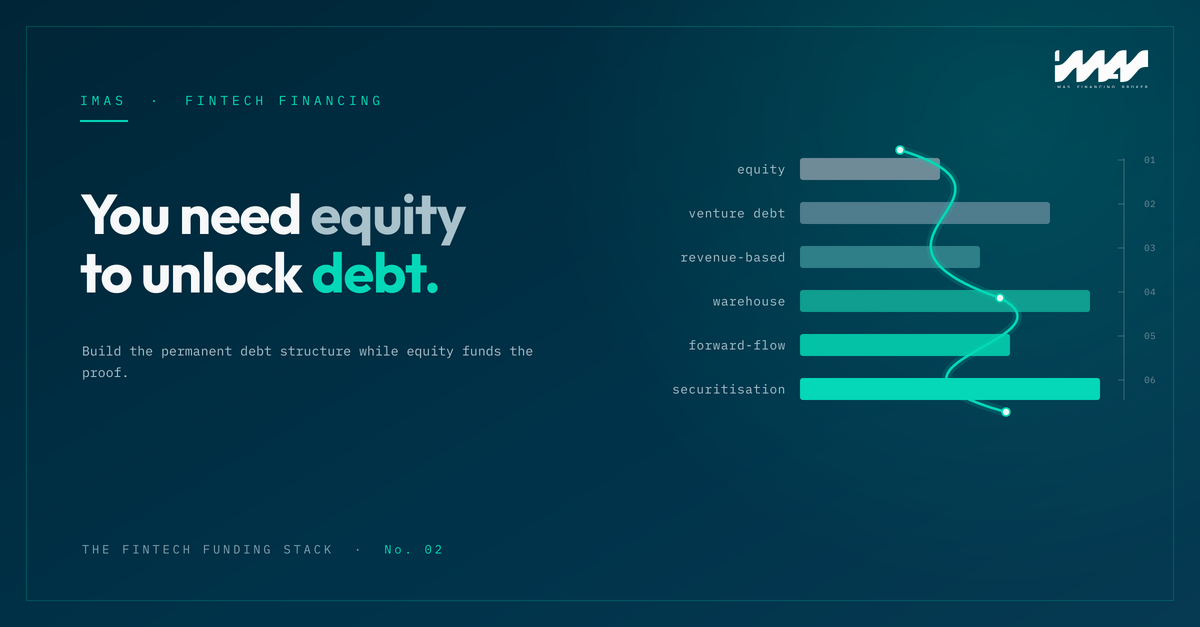
With the architecture in place, the journey from equity-seeded to self-funding stops being a series of emergencies: an equity-seeded pilot proves the unit economics and generates six to twelve months of clean vintages; a first warehouse advances against assets that are already eligible and correctly structured, with equity stepping back into a thin first-loss slice; a forward-flow takes future originations without touching the cap table; and, at scale, securitisation or a permanent takeout reaches the lowest cost of capital. Each step plugs into what already exists.
The endgame
The destination is a flow that funds itself. Equity is reserved for what compounds — product, team, expansion — while the book grows on structured debt priced off its own proven performance, and you stop selling shares to buy growth in your own receivables. The counter-intuitive truth: the cheapest way to fund your flow for the long term is to spend some of your earliest, most expensive equity building the structure that will eventually replace it. The founders who get there on schedule are rarely the ones who raised the most — they are the ones who drew the endgame before the first asset was written.
The Day-1 Flow-Funding Architecture
The structure, documentation and data to put in place now — while you're still equity-funded — so your pilot converts cleanly into a warehouse, forward-flow and securitisation. If you're at or near pilot stage, this is the moment to design the endgame.
Related service: FinTech Advisory →